27 sourcesFirst reported today at 00:00, updated 1 h ago
PM visits JERA’s LNG terminal, power plant in Japan
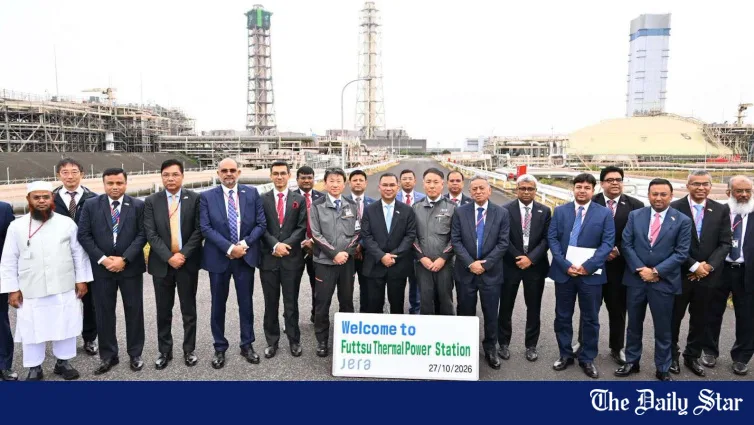
Photo: The Daily Star
Neutral summary
Prime Minister Tarique Rahman visited the onshore liquefied natural gas (LNG) terminal and power plant of JERA, a Japanese energy company, in Futtsu city, Chiba Prefecture, Japan, on Tuesday, 27 October 2026, at about 2:30pm local time, as part of his official visit to Japan. He was accompanied by a delegation of senior government officials, including Finance and Planning Minister Amir Khosru Mahmud Chowdhury, Civil Aviation and Tourism Minister M Rashiduzzaman Millat, State Minister for Power, Energy and Mineral Resources Aninda Islam Amit, Invest Bangladesh Authority Chairman Ashik Chowdhury and Bangladesh Bank Governor Mostaqur Rahman. Foreign Secretary Asad Alam Siam and Economic Relations Division Secretary Shahriar Kader Siddiky were also present.
 The Daily Star
 United News of Bangladesh (UNB)
 Jugantor
 The Financial Express
 Amar Desh
Written by AI from these outlets' articles: facts they report, claims attributed, numbers checked against the sources. It may still contain errors; read the originals.
Article analysis
 Channel 24
 Amar Sangbad
 Jago News 24
 Kalbela
 Desh Rupantor
 Banglavision
 Ekattor TV
 The Daily Ittefaq
 Independent Television
The Daily Star1
 New Age
 Manab Zamin
 Bangladesh Bulletin
United News of Bangladesh (UNB)
 The Daily Observer
Jugantor
 Dhaka Post
 Bangladesh Pratidin
 Bangladesh Sangbad Sangstha (BSS)
 RTV
 Boishakhi Television
 Daily Naya Diganta
The Financial Express
 Banglanews24.com
Amar Desh
 Samakal
 Ekushey Television (ETV)
Band AStraight reporting
The Daily StarNeutral
Plainly reports the prime minister's visit to JERA's facilities in the headline and lists the delegation in descriptive narration without evaluation.
27 of the 27 outlets that covered this event headlined it neutrally.
Nothing in the headline, sourcing or narration pushes the reader.
1 Straight reporting10 Campaigning
The same event, one framing
The earliest headline of each kind. Marked words are judgements in the headline itself: stated as fact or in quotation marks.
Neutral 27 of 27
জাপানে এলএনজি টার্মিনাল ও বিদ্যুৎকেন্দ্র পরিদর্শন করলেন প্রধানমন্ত্রী
Channel 24
How the 1 was worked out
The model answers seven fixed questions from 0 to 3 and cites evidence for each. The score is calculated from the answers in code, so any disagreement points to one question.
-
G1
Reporter's own voiceNarration is descriptive throughout.0
-
G2
HeadlineReports the event or the speech act; contested claims are attributed.0
-
G3
Other side missingEvery party involved responds substantively.0
-
G4
Weight of the unanswered allegationNo allegation against an identifiable party.0
-
G5
Loaded quotesQuotes are informational.0
-
G6
Unattributed claimsEvery disputable claim is attributed.0
-
G7
Missing contextNecessary background is present.0
Evidence
Show the calculation
S = G2 + … + G7 = 0 + 0 + 0 + 0 + 0 + 0 = 0
G1 = 0, below 2: not band D
G1 = 0 and S ≤ 1: band A
Band A: S = 0 gives 1, S = 1 gives 2. Score 1
Every headline, in order
-
Channel 24
Bangladesh
First to report
Neutral
জাপানে এলএনজি টার্মিনাল ও বিদ্যুৎকেন্দ্র পরিদর্শন করলেন প্রধানমন্ত্রী
-
Kalbela
Bangladesh
Neutral
জাপানে এলএনজি টার্মিনাল ও বিদ্যুৎকেন্দ্র পরিদর্শন প্রধানমন্ত্রীর
-
Banglavision
Bangladesh
Neutral
জাপানে এলএনজি টার্মিনাল ও বিদ্যুৎকেন্দ্র পরিদর্শনে প্রধানমন্ত্রী
-
Ekattor TV
Bangladesh
Neutral
জাপানের জেরা বিদ্যুৎকেন্দ্র ও এলএনজি টার্মিনাল পরিদর্শনে প্রধানমন্ত্রী
-
The Daily Star
Bangladesh
Analysed above
Neutral
-
The Daily Observer
Bangladesh
Neutral
-
Jugantor
Bangladesh
Neutral
জাপানে এলএনজি টার্মিনাল ও বিদ্যুৎকেন্দ্র পরিদর্শন করলেন প্রধানমন্ত্রী
-
Dhaka Post
Bangladesh
Neutral
জেরা’র এলএনজি টার্মিনাল ও বিদ্যুৎকেন্দ্র পরিদর্শন করেছেন প্রধানমন্ত্রী
-
RTV
Bangladesh
Neutral
জাপানে জেরা’র এলএনজি টার্মিনাল ও বিদ্যুৎকেন্দ্র পরিদর্শন প্রধানমন্ত্রীর
-
The Financial Express
Bangladesh
Neutral
About this method
Method. Bias types follow the Table of Media Bias Elements and the Media Bias Taxonomy (both CC BY 4.0). The impartiality rules follow the BBC Editorial Guidelines and the Ofcom Broadcasting Code. This analysis was made by claude-opus-5-5 on rubric 1.0.0. The score is calculated from the seven answers, never generated.
What this is not. No outlet gets a standing bias rating, and there is no left/right axis, because that axis does not describe Bangladeshi politics. Each analysis covers one article about one event. Members' analytics count how each outlet's headlines were labelled over a chosen period, with the number of headlines behind every share, and also show the average score of an outlet's scored articles: that average describes those articles (mostly each story's lead), not the outlet, and outlets are never ranked by it or by any share.
Known limits. Headlines are grouped into stories automatically, so an unrelated headline sometimes slips in; it is shown faded rather than hidden. Where outlets carry the same wire copy, the comparison has little to show. Human annotators agree on bias in Bangla news only moderately (κ = 0.574 at best), which limits what any automated score can claim.