6 sourcesFirst reported today at 04:23, updated 55 min ago
জাপানকে বাংলাদেশের পরীক্ষিত বন্ধু বললেন প্রধানমন্ত্রী
prime minister calls Japan a tested friend of Bangladesh
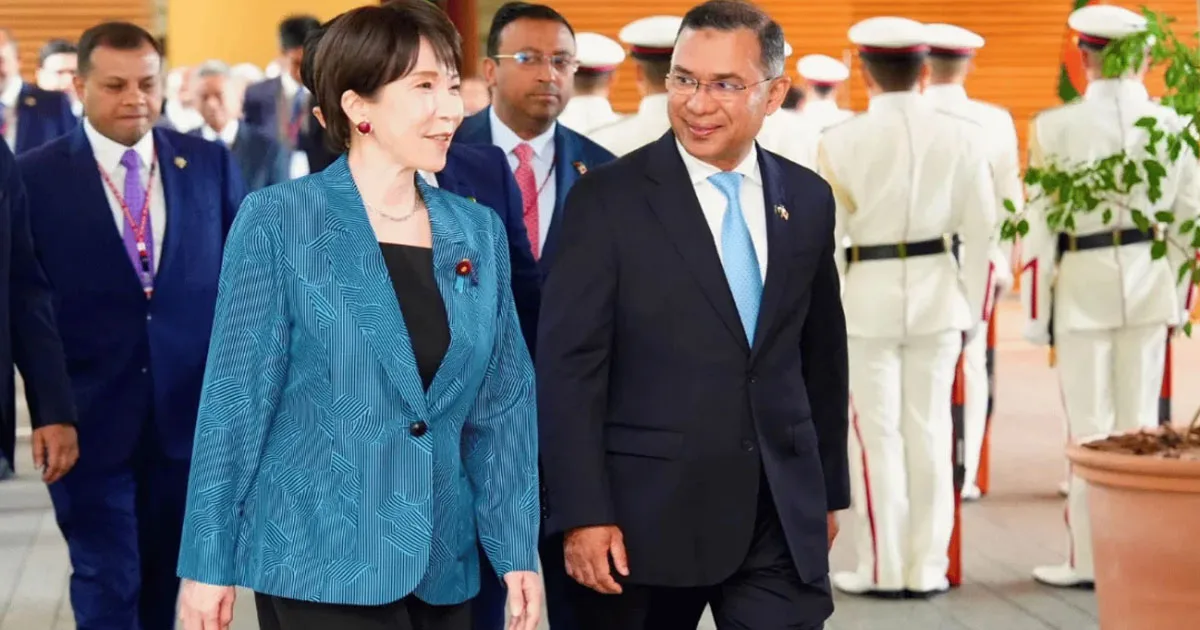
Photo: Bangla Edition
Neutral summary
Prime Minister Tarique Rahman called Japan a tested and trusted friend of Bangladesh over several decades, saying the bilateral partnership should now be taken to a new height. Speaking at a joint news briefing in Tokyo on Tuesday morning after a formal bilateral meeting with Japanese Prime Minister Sanae Takaichi, he said both sides agreed to strengthen cooperation in energy, ICT, railway and communications infrastructure, deep-sea ports and foreign direct investment. Several memoranda of understanding were exchanged during the visit, with details to be released in a joint statement. Rahman urged Japanese investors and businesses to explore opportunities in Bangladesh. He arrived in Tokyo on Monday for a four-day official visit, and a Japanese delegation led by former prime minister Taro Aso also met him.
 Bangla Edition
 Channel i
Written by AI from these outlets' articles: facts they report, claims attributed, numbers checked against the sources. It may still contain errors; read the originals.
Article analysis
Band BLocalised faults
Bangla EditionNeutral
Attributes the friendship remarks to the prime minister in headline and body, with narration largely descriptive apart from an unattributed claim of broad Japanese investor interest.
Six of the six outlets that covered this event headlined it neutrally.
The faults are local; the reporter's narration stays descriptive.
1 Straight reporting10 Campaigning
The same event, one framing
The earliest headline of each kind. Marked words are judgements in the headline itself: stated as fact or in quotation marks.
Neutral 6 of 6
জাপানকে বাংলাদেশের পরীক্ষিত বন্ধু বললেন প্রধানমন্ত্রী তারেক রহমান
 The Daily Ittefaq
How the 3 was worked out
The model answers seven fixed questions from 0 to 3 and cites evidence for each. The score is calculated from the answers in code, so any disagreement points to one question.
-
G1
Reporter's own voiceOne isolated evaluative word in the reporter's voice. Evidence 11
-
G2
HeadlineReports the event or the speech act; contested claims are attributed.0
-
G3
Other side missingEvery party involved responds substantively.0
-
G4
Weight of the unanswered allegationNo allegation against an identifiable party.0
-
G5
Loaded quotesQuotes are informational.0
-
G6
Unattributed claimsOne or two disputable claims are unattributed. Evidence 11
-
G7
Missing contextNecessary background is present.0
Evidence
1MagnitudeReporter voice
ব্যাপক আগ্রহ প্রকাশ পায়
Unquantified scale word for investor interest stated in reporter voice without attribution.
2Word choiceReporter voice· not scored
উষ্ণ অভ্যর্থনা জানান
Mildly evaluative descriptor of the welcome in narration, conventional diplomatic phrasing.
3Source selectionReporter voice· not scored
দ্বিপক্ষীয় বৈঠকের বিষয়ে সরকারপ্রধান জানান
Meeting outcomes relayed solely from the Bangladeshi PM, no Japanese side account; routine for this genre.
Show the calculation
S = G2 + … + G7 = 0 + 0 + 0 + 0 + 1 + 0 = 1
G1 = 1, below 2: not band D
Not band C or A: band B
Band B: S ≤ 3 gives 3, 4 to 6 gives 4, 7 or more gives 5. Score 3
Every headline, in order
-
The Daily Ittefaq
Bangladesh
First to report
Neutral
জাপানকে বাংলাদেশের পরীক্ষিত বন্ধু বললেন প্রধানমন্ত্রী তারেক রহমান
-
Bangla Edition
Bangladesh
Analysed above
Neutral
-
 Gonokantho
Bangladesh
Neutral
জাপানকে বাংলাদেশের পরীক্ষিত বন্ধু বললেন প্রধানমন্ত্রী তারেক রহমান
-
Channel i
Bangladesh
Neutral
-
 Jugantor
Bangladesh
Neutral
-
 ATN Bangla
Bangladesh
Neutral
About this method
Method. Bias types follow the Table of Media Bias Elements and the Media Bias Taxonomy (both CC BY 4.0). The impartiality rules follow the BBC Editorial Guidelines and the Ofcom Broadcasting Code. This analysis was made by claude-opus-5-5 on rubric 1.0.0. The score is calculated from the seven answers, never generated.
What this is not. No outlet gets a standing bias rating, and there is no left/right axis, because that axis does not describe Bangladeshi politics. Each analysis covers one article about one event. Members' analytics count how each outlet's headlines were labelled over a chosen period, with the number of headlines behind every share, and also show the average score of an outlet's scored articles: that average describes those articles (mostly each story's lead), not the outlet, and outlets are never ranked by it or by any share.
Known limits. Headlines are grouped into stories automatically, so an unrelated headline sometimes slips in; it is shown faded rather than hidden. Where outlets carry the same wire copy, the comparison has little to show. Human annotators agree on bias in Bangla news only moderately (κ = 0.574 at best), which limits what any automated score can claim.