3 sourcesFirst reported yesterday at 15:27, updated 20 h ago
PM’s Japan visit to renew investment ties, recover lost opportunities: Humaiun
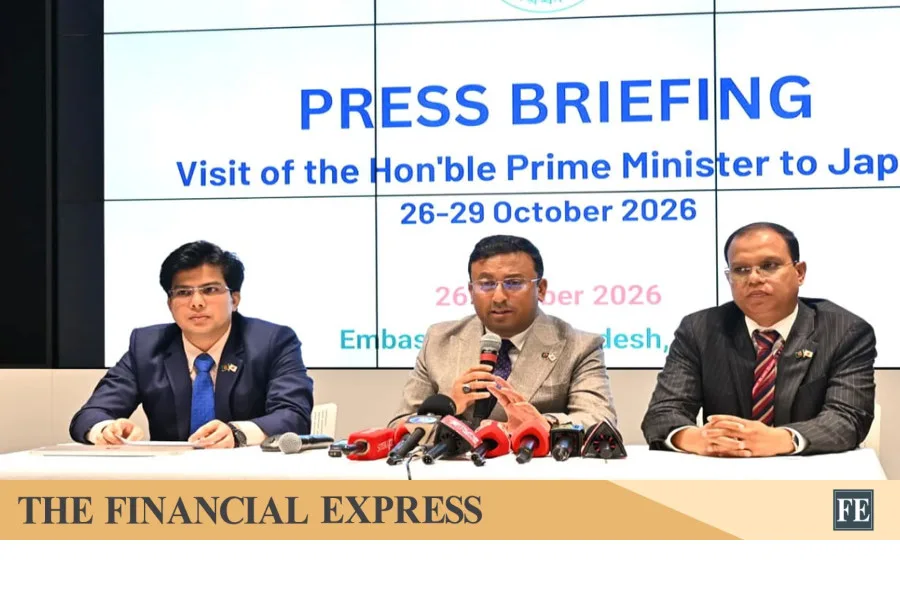
Photo: The Financial Express
Neutral summary
Prime Minister Tarique Rahman began a four-day state visit to Japan on Monday, according to State Minister for Foreign Affairs Humaiun Kobir, who briefed reporters at the Bangladesh Embassy in Tokyo. Kobir said the visit offers an opportunity to recover business and investment opportunities missed over the past 15 years, and blamed a trust deficit and corruption under the previous Sheikh Hasina government for hindering ties. On the first day, Rahman met a Japanese parliamentary delegation led by former prime minister Taro Aso, Marubeni Corporation Chairman Masumi Kakinoki, and JICA President Akihiko Tanaka, covering trade, investment, infrastructure and fertiliser plant plans. The day ended with a dinner hosted by Nippon Foundation Chairman Yohei Sasakawa. Bilateral talks with Japanese Prime Minister Sanae Takaichi are scheduled for Tuesday.
 The Financial Express
 Bangladesh Post
Written by AI from these outlets' articles: facts they report, claims attributed, numbers checked against the sources. It may still contain errors; read the originals.
Article analysis
Bangladesh PostNeutral
This article has not been scored yet.
Each story's lead article is scored automatically. Members can have any other outlet's article scored on request, for €9 a month.
Become a memberThe same event, one framing
The earliest headline of each kind. Marked words are judgements in the headline itself: stated as fact or in quotation marks.
Neutral 3 of 3
PM’s Japan visit to renew investment ties, recover lost opportunities: Humaiun
 Bangladesh Sangbad Sangstha (BSS)
Every headline, in order
-
Bangladesh Sangbad Sangstha (BSS)
Bangladesh
First to report
Neutral
PM’s Japan visit to renew investment ties, recover lost opportunities: Humaiun
-
Bangladesh Post
Bangladesh
Selected above
Neutral
PM’s Japan visit aims to revive lost investment opportunities
About this method
Method. Bias types follow the Table of Media Bias Elements and the Media Bias Taxonomy (both CC BY 4.0). The impartiality rules follow the BBC Editorial Guidelines and the Ofcom Broadcasting Code. The score is calculated from the seven answers, never generated.
What this is not. No outlet gets a standing bias rating, and there is no left/right axis, because that axis does not describe Bangladeshi politics. Each analysis covers one article about one event. Members' analytics count how each outlet's headlines were labelled over a chosen period, with the number of headlines behind every share, and also show the average score of an outlet's scored articles: that average describes those articles (mostly each story's lead), not the outlet, and outlets are never ranked by it or by any share.
Known limits. Headlines are grouped into stories automatically, so an unrelated headline sometimes slips in; it is shown faded rather than hidden. Where outlets carry the same wire copy, the comparison has little to show. Human annotators agree on bias in Bangla news only moderately (κ = 0.574 at best), which limits what any automated score can claim.