3 sourcesFirst reported yesterday at 15:27, updated 16 h ago
PM’s Japan visit to renew investment ties, recover lost opportunities: Humaiun
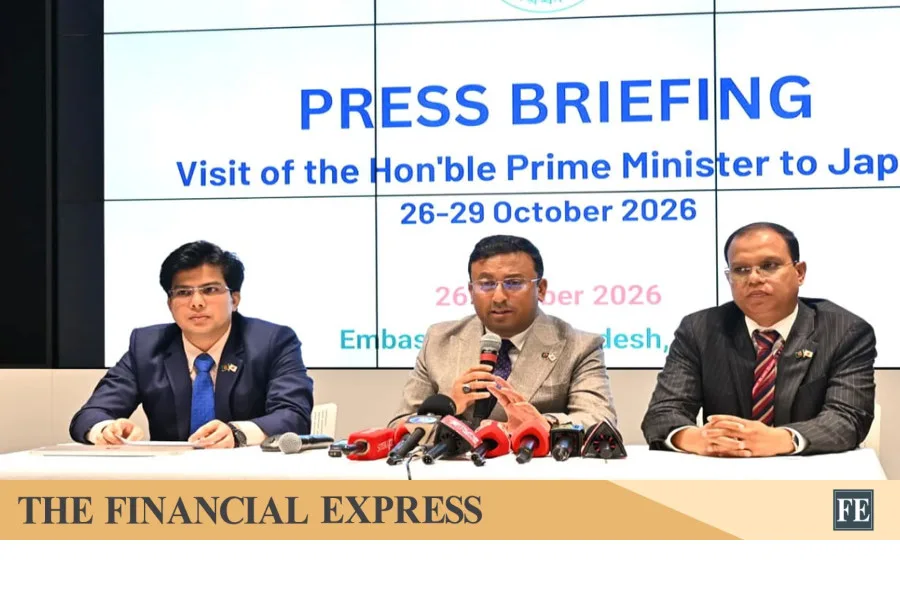
Photo: The Financial Express
Neutral summary
Prime Minister Tarique Rahman began a four-day state visit to Japan on Monday, according to State Minister for Foreign Affairs Humaiun Kobir, who briefed reporters at the Bangladesh Embassy in Tokyo. Kobir said the visit offers an opportunity to recover business and investment opportunities missed over the past 15 years, and blamed a trust deficit and corruption under the previous Sheikh Hasina government for hindering ties. On the first day, Rahman met a Japanese parliamentary delegation led by former prime minister Taro Aso, Marubeni Corporation Chairman Masumi Kakinoki, and JICA President Akihiko Tanaka, covering trade, investment, infrastructure and fertiliser plant plans. The day ended with a dinner hosted by Nippon Foundation Chairman Yohei Sasakawa. Bilateral talks with Japanese Prime Minister Sanae Takaichi are scheduled for Tuesday.
 The Financial Express
 Bangladesh Post
Written by AI from these outlets' articles: facts they report, claims attributed, numbers checked against the sources. It may still contain errors; read the originals.
Article analysis
Band BLocalised faults
The Financial ExpressNeutral
Relays the state minister's framing of the visit largely uncritically, with the lede adopting his 'missed opportunities' claim and an attributed corruption charge against the previous government left unanswered.
Three of the three outlets that covered this event headlined it neutrally.
The faults are local; the reporter's narration stays descriptive.
1 Straight reporting10 Campaigning
The same event, one framing
The earliest headline of each kind. Marked words are judgements in the headline itself: stated as fact or in quotation marks.
Neutral 3 of 3
PM’s Japan visit to renew investment ties, recover lost opportunities: Humaiun
 Bangladesh Sangbad Sangstha (BSS)
How the 5 was worked out
The model answers seven fixed questions from 0 to 3 and cites evidence for each. The score is calculated from the answers in code, so any disagreement points to one question.
-
G1
Reporter's own voiceOne isolated evaluative word in the reporter's voice. Evidence 11
-
G2
HeadlineCompresses or intensifies, but the claim stays attributed. Evidence 11
-
G3
Other side missingThe other side is absent, with no sign a response was sought.3
-
G4
Weight of the unanswered allegationAllegation of misconduct, bad faith or incompetence. Evidence 22
-
G5
Loaded quotesSome evaluative words in quotes, in proportion to the event. Evidence 21
-
G6
Unattributed claimsOne or two disputable claims are unattributed. Evidence 11
-
G7
Missing contextNecessary background is present.0
Evidence
1Unsubstantiated claimReporter voice
offers an opportunity to recover business and investment opportunities missed over the past 15 years
The lede states the minister's framing of missed opportunities under the prior government as fact, without attribution in that sentence.
2Word choiceAttributed quote voice
A trust deficit and corruption had hindered bilateral relations
The quote accuses the previous government of corruption, but it is clearly attributed to the minister.
4Source selectionReporter voice· not scored
Kobir said the meetings demonstrated the scope
Every account of the visit comes from government officials, with no independent sources.
5Word choiceParaphrased source voice· not scored
Shaheed President Ziaur Rahman
A partisan honorific used in paraphrase of the minister, for a referent that is conventionally settled.
Show the calculation
S = G2 + … + G7 = 1 + 3 + 2 + 1 + 1 + 0 = 8
G1 = 1, below 2: not band D
Not band C or A: band B
Band B: S ≤ 3 gives 3, 4 to 6 gives 4, 7 or more gives 5. Score 5
Checks applied in code. f3: reporter voice inside a quotation, dropped.
Every headline, in order
-
Bangladesh Sangbad Sangstha (BSS)
Bangladesh
First to report
Neutral
PM’s Japan visit to renew investment ties, recover lost opportunities: Humaiun
-
The Financial Express
Bangladesh
Analysed above
Neutral
PM’s Japan visit to renew investment ties, recover lost opportunities: Humaiun
-
Bangladesh Post
Bangladesh
Neutral
PM’s Japan visit aims to revive lost investment opportunities
About this method
Method. Bias types follow the Table of Media Bias Elements and the Media Bias Taxonomy (both CC BY 4.0). The impartiality rules follow the BBC Editorial Guidelines and the Ofcom Broadcasting Code. This analysis was made by claude-opus-5-5 on rubric 1.0.0. The score is calculated from the seven answers, never generated.
What this is not. No outlet gets a standing bias rating, and there is no left/right axis, because that axis does not describe Bangladeshi politics. Each analysis covers one article about one event. Members' analytics count how each outlet's headlines were labelled over a chosen period, with the number of headlines behind every share, and also show the average score of an outlet's scored articles: that average describes those articles (mostly each story's lead), not the outlet, and outlets are never ranked by it or by any share.
Known limits. Headlines are grouped into stories automatically, so an unrelated headline sometimes slips in; it is shown faded rather than hidden. Where outlets carry the same wire copy, the comparison has little to show. Human annotators agree on bias in Bangla news only moderately (κ = 0.574 at best), which limits what any automated score can claim.