11 sourcesFirst reported yesterday at 12:00, updated 2 h ago
জ্বালানি, প্রযুক্তি ও অবকাঠামোতে সহযোগিতা বাড়ানোর ওপর গুরুত্ব
emphasis on boosting cooperation in energy technology and infrastructure
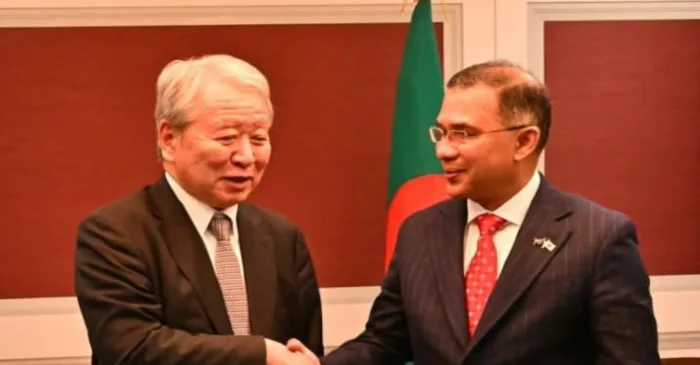
Photo: Daily Manobkantha
Neutral summary
Prime Minister Tarique Rahman arrived in Tokyo on Monday, 26 October, for a four-day official visit at the invitation of Japanese Prime Minister Sanae Takaichi, his first trip abroad since the BNP formed government. He was greeted at Narita airport by Japanese Foreign Minister Yasutaka Nakasone. Rahman met former Prime Minister Taro Aso, Marubeni chairman Masumi Kakinoki and JICA President Akihiko Tanaka. According to Deputy Press Secretary Shahadat Swadhin and the reports, he sought Japanese investment in automobiles, IT, renewable energy and fertiliser plants, and help with a Karnaphuli fertiliser factory upgrade, technology transfer, and energy security, including budget support as in the previous year. He asked JICA for concessional loans and completion of ongoing projects. A bilateral summit with Takaichi was scheduled for Tuesday, 27 October, in Tokyo, and Rahman was to address a Japan-Bangladesh economic forum.
Where accounts differ. Banglavision attributes the energy-security and investment briefing to Foreign State Minister Humayun Kabir, while Desh TV and Manobkantha attribute the details to Deputy Press Secretary Shahadat Swadhin; UNB reports only the headlines.
 Daily Manobkantha
 United News of Bangladesh (UNB)
 Desh TV
 Banglavision
Written by AI from these outlets' articles: facts they report, claims attributed, numbers checked against the sources. It may still contain errors; read the originals.
Article analysis


Band BLocalised faults
Daily ManobkanthaNeutral
Reports the prime minister's meeting with JICA descriptively under a speech-act headline, with one evaluative adjective in narration echoing the government readout.
Eleven of the eleven outlets that covered this event headlined it neutrally.
The faults are local; the reporter's narration stays descriptive.
1 Straight reporting10 Campaigning
The same event, one framing
The earliest headline of each kind. Marked words are judgements in the headline itself: stated as fact or in quotation marks.
Neutral 11 of 11
বাংলাদেশের জ্বালানি নিরাপত্তায় জাইকার সহযোগিতা চাইলেন তারেক রহমান
Daily Manobkantha
How the 3 was worked out
The model answers seven fixed questions from 0 to 3 and cites evidence for each. The score is calculated from the answers in code, so any disagreement points to one question.
-
G1
Reporter's own voiceOne isolated evaluative word in the reporter's voice. Evidence 11
-
G2
HeadlineReports the event or the speech act; contested claims are attributed.0
-
G3
Other side missingEvery party involved responds substantively.0
-
G4
Weight of the unanswered allegationNo allegation against an identifiable party.0
-
G5
Loaded quotesQuotes are informational.0
-
G6
Unattributed claimsEvery disputable claim is attributed.0
-
G7
Missing contextNecessary background is present.0
Evidence
1Word choiceReporter voice
ফলপ্রসূ বৈঠকের
Describes the earlier meeting as fruitful in narration, likely echoing the PM's framing without attribution.
2Source selectionReporter voice· not scored
জাইকার প্রেসিডেন্ট বাংলাদেশের সমৃদ্ধি অর্জনে একসঙ্গে কাজ করার অঙ্গীকার পুনর্ব্যক্ত করেন।
Account appears drawn from the government side's readout with JICA's response reduced to one line, but no party is accused.
Show the calculation
S = G2 + … + G7 = 0 + 0 + 0 + 0 + 0 + 0 = 0
G1 = 1, below 2: not band D
Not band C or A: band B
Band B: S ≤ 3 gives 3, 4 to 6 gives 4, 7 or more gives 5. Score 3
Every headline, in order
-
Daily Manobkantha
Bangladesh
Analysed above
Neutral
বাংলাদেশের জ্বালানি নিরাপত্তায় জাইকার সহযোগিতা চাইলেন তারেক রহমান
-
Banglavision
Bangladesh
Neutral
-
 Kalbela
Bangladesh
Neutral
জ্বালানি, প্রযুক্তি ও বিনিয়োগে জাপানকে পাশে চান তারেক রহমান
-
 The Daily Ittefaq
Bangladesh
Neutral
জ্বালানি, প্রযুক্তি ও অবকাঠামোতে সহযোগিতা বাড়ানোর ওপর গুরুত্ব
About this method
Method. Bias types follow the Table of Media Bias Elements and the Media Bias Taxonomy (both CC BY 4.0). The impartiality rules follow the BBC Editorial Guidelines and the Ofcom Broadcasting Code. This analysis was made by claude-opus-5-5 on rubric 1.0.0. The score is calculated from the seven answers, never generated.
What this is not. No outlet gets a standing bias rating, and there is no left/right axis, because that axis does not describe Bangladeshi politics. Each analysis covers one article about one event. Members' analytics count how each outlet's headlines were labelled over a chosen period, with the number of headlines behind every share, and also show the average score of an outlet's scored articles: that average describes those articles (mostly each story's lead), not the outlet, and outlets are never ranked by it or by any share.
Known limits. Headlines are grouped into stories automatically, so an unrelated headline sometimes slips in; it is shown faded rather than hidden. Where outlets carry the same wire copy, the comparison has little to show. Human annotators agree on bias in Bangla news only moderately (κ = 0.574 at best), which limits what any automated score can claim.