6 sourcesFirst reported yesterday at 04:01, updated 4 h ago
Baby orangutans in India expose illegal wildlife trade as experts question a billionaire’s zoo
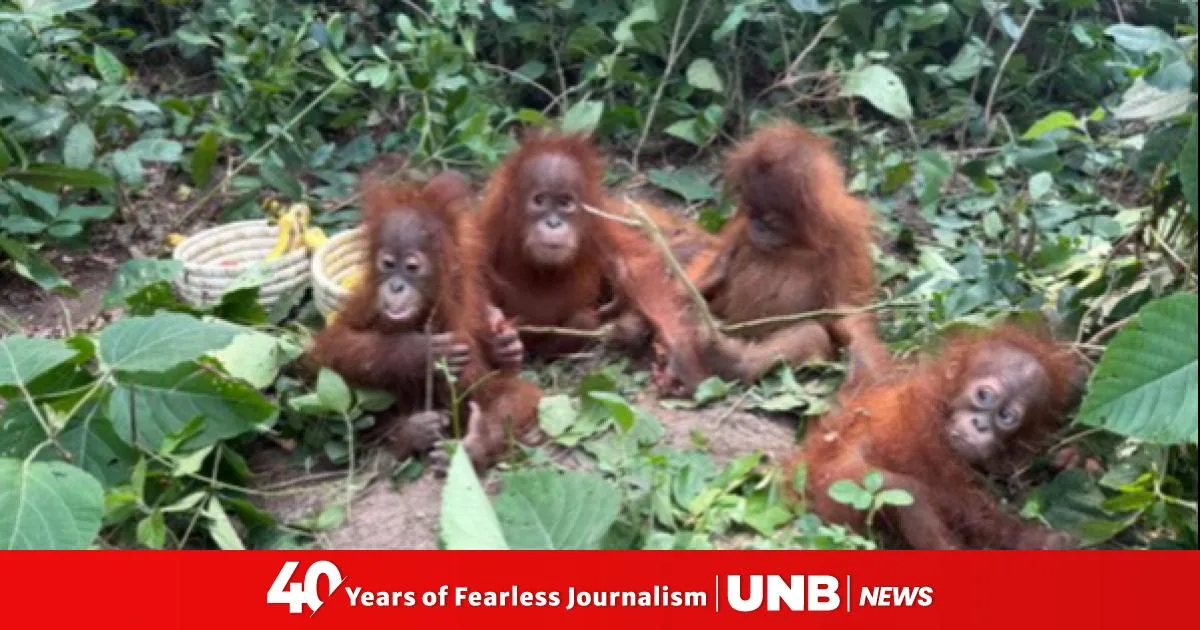
Photo: United News of Bangladesh (UNB)
Neutral summary
Five baby orangutans, three males and two females aged 6 to 8 months, were found abandoned on a plantation in Odisha, eastern India, more than 2,700 kilometres from their native Borneo and Sumatra, after villagers spotted them in early September. They are now at an Indian zoo, where keepers have reportedly played classical music to soothe them. Experts said the discovery points to a growing illicit trade in apes trafficked into India, which Sinan Serhadli of the Orangutan Information Centre called the number one destination for live primate trade. Uttara Mendiratta, a wildlife trafficking researcher, said wealthy collectors drive demand. Serhadli questioned whether 41 orangutans imported by India between 2021 and 2024 were legitimately captive-bred; CITES declined to comment, saying the matter was under review. Indonesia's Ministry of Forestry said it was taking active steps to repatriate the orangutans and had sent experts. The infants' mothers were likely killed. An orangutan transferred last year to Vantara, a private facility run by Mukesh Ambani's family, was returned to Indonesia on October 19 after 19 months. India's forest ministry did not respond to requests for comment.
Where accounts differ. Kyodo News and UNB report that Vantara's statement said it fully supported the orangutan's return, a response that appears only in Kyodo News, while The Daily Waadaa and UNB do not include it.
 United News of Bangladesh (UNB)
 The Daily Waadaa
 Kyodo News
Written by AI from these outlets' articles: facts they report, claims attributed, numbers checked against the sources. It may still contain errors; read the originals.
Article analysis


Band BLocalised faults
The Daily WaadaaStated as fact
Largely sourced report on primate trafficking whose headline spotlights a billionaire's zoo; Vantara's response to the Tapanuli allegation is absent, though the Supreme Court clearance is noted.
Five of the six outlets that covered this event headlined it neutrally, so this framing was a choice the story did not require.
The faults are local; the reporter's narration stays descriptive.
1 Straight reporting10 Campaigning
The same event, two framings
The earliest headline of each kind. Marked words are judgements in the headline itself: stated as fact or in quotation marks.
Neutral 5 of 6
Baby orangutans in India expose illegal wildlife trade as experts question a billionaire’s zoo
 Associated Press
Stated as fact 1 of 6
Baby orangutans in India expose illegal wildlife trade as experts question a billionaire’s zoo
The Daily Waadaa
How the 5 was worked out
The model answers seven fixed questions from 0 to 3 and cites evidence for each. The score is calculated from the answers in code, so any disagreement points to one question.
-
G1
Reporter's own voiceOne isolated evaluative word in the reporter's voice. Evidence 21
-
G2
HeadlineCompresses or intensifies, but the claim stays attributed. Evidence 11
-
G3
Other side missingThe other side is absent, but the article says a response was sought. Evidence 32
-
G4
Weight of the unanswered allegationAllegation of misconduct, bad faith or incompetence. Evidence 32
-
G5
Loaded quotesSome evaluative words in quotes, in proportion to the event. Evidence 51
- G6 1
-
G7
Missing contextNecessary background is present.0
Evidence
1Headline-body attribution mismatchHeadline voice
experts question a billionaire’s zoo
Headline foregrounds the billionaire framing, though questioning is attributed to experts and supported by the body.
2Unsubstantiated claimReporter voice
Their discovery points to a growing illicit trade in apes trafficked into India.
Inferential claim of a growing trade stated in reporter voice before experts are cited.
3CoverageReporter voice
Vantara describes itself as a wildlife rescue and rehabilitation centre.
Vantara is scrutinised at length but gives no response to the Tapanuli allegation and no comment request is mentioned.
4Unsubstantiated claimReporter voice
The infants’ mothers were likely killed
Conjecture stated without attribution.
5Word choiceAttributed quote voice
And ... corruption as well
Quoted expert alleges corruption; source rhetoric, proportionate.
Show the calculation
S = G2 + … + G7 = 1 + 2 + 2 + 1 + 1 + 0 = 7
G1 = 1, below 2: not band D
Not band C or A: band B
Band B: S ≤ 3 gives 3, 4 to 6 gives 4, 7 or more gives 5. Score 5
Every headline, in order
-
Associated Press
US & Canada
First to report
Neutral
Baby orangutans in India expose illegal wildlife trade as experts question a billionaire’s zoo
-
The Daily Waadaa
Bangladesh
Analysed above
Stated as fact
Baby orangutans in India expose illegal wildlife trade as experts question a billionaire’s zoo
About this method
Method. Bias types follow the Table of Media Bias Elements and the Media Bias Taxonomy (both CC BY 4.0). The impartiality rules follow the BBC Editorial Guidelines and the Ofcom Broadcasting Code. This analysis was made by claude-opus-5-5 on rubric 1.0.0. The score is calculated from the seven answers, never generated.
What this is not. No outlet gets a standing bias rating, and there is no left/right axis, because that axis does not describe Bangladeshi politics. Each analysis covers one article about one event. Members' analytics count how each outlet's headlines were labelled over a chosen period, with the number of headlines behind every share, and also show the average score of an outlet's scored articles: that average describes those articles (mostly each story's lead), not the outlet, and outlets are never ranked by it or by any share.
Known limits. Headlines are grouped into stories automatically, so an unrelated headline sometimes slips in; it is shown faded rather than hidden. Where outlets carry the same wire copy, the comparison has little to show. Human annotators agree on bias in Bangla news only moderately (κ = 0.574 at best), which limits what any automated score can claim.