18 sourcesFirst reported Sun 25 Oct at 14:11, updated 2 h ago
মাথাপিছু আয়ে ভারতকে পেছনে ফেলছে বাংলাদেশ
Bangladesh overtaking India in per capita income
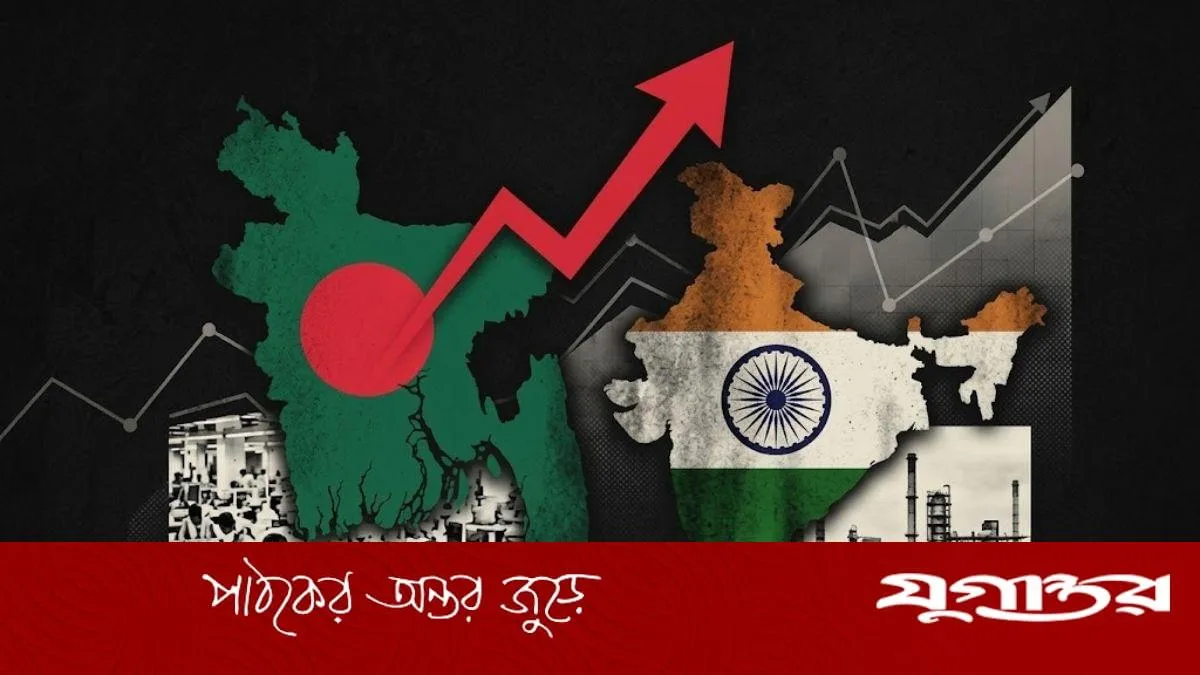
Photo: Jugantor
Neutral summary
The International Monetary Fund's October 2026 World Economic Outlook projects Bangladesh's per capita GDP at $2,886 in 2026, above India's $2,749, though India's GDP is about eight times larger. Al Jazeera reported that experts attribute Bangladesh's progress to its $38bn garment industry, remittances and rising female workforce participation. The IMF projects Bangladesh's consumer-price inflation at 8.7 percent against 5 percent in India, and growth of 3.6 percent against India's 7 percent. Adjusted for purchasing power parity, India's per capita GDP is projected at $12,998 against Bangladesh's $10,884. The IMF projects India will regain the lead in 2029. Indian economist Santosh Mehrotra, quoted by Al Jazeera, called Bangladesh's manufacturing growth a positive sign. Analysts cautioned that averages hide income inequality. Outlets also cited disruption to Strait of Hormuz and Red Sea shipping from the Middle East conflict, which affects Bangladesh's fuel imports and garment exports.
Where accounts differ. Jugantor and Ajker Patrika describe the Hormuz and Red Sea disruption as a major threat, while Al Jazeera and Amar Desh attribute it to the US-Israel war with Iran; Amar Desh alone notes Bangladesh led India for seven years from 2018.
 Al Jazeera English
 Jugantor
 Amar Desh
 Daily Manobkantha
 Ajker Patrika
Written by AI from these outlets' articles: facts they report, claims attributed, numbers checked against the sources. It may still contain errors; read the originals.
Article analysis


Band BLocalised faults
Al Jazeera EnglishNeutral
Reports IMF projections with an attributed, plainly factual headline and largely descriptive narration that includes PPP, inflation and growth caveats, with one mildly evaluative success-story phrase.
Eighteen of the eighteen outlets that covered this event headlined it neutrally.
The faults are local; the reporter's narration stays descriptive.
1 Straight reporting10 Campaigning
The same event, one framing
The earliest headline of each kind. Marked words are judgements in the headline itself: stated as fact or in quotation marks.
Neutral 18 of 18
Bangladesh per capita GDP forecast to outstrip India’s: What does it mean?
Al Jazeera English
How the 3 was worked out
The model answers seven fixed questions from 0 to 3 and cites evidence for each. The score is calculated from the answers in code, so any disagreement points to one question.
-
G1
Reporter's own voiceOne isolated evaluative word in the reporter's voice. Evidence 11
-
G2
HeadlineReports the event or the speech act; contested claims are attributed.0
-
G3
Other side missingEvery party involved responds substantively.0
-
G4
Weight of the unanswered allegationNo allegation against an identifiable party.0
-
G5
Loaded quotesQuotes are informational.0
-
G6
Unattributed claimsEvery disputable claim is attributed.0
-
G7
Missing contextNecessary background is present.0
Evidence
1Word choiceReporter voice
one of South Asia’s notable economic success stories
Mildly evaluative framing in narration, though broadly supported by cited data and experts.
2Word choiceReporter voice· not scored
the United States-Israel war on Iran
Characterizes a contested conflict in the paper's voice without attribution, though incidental to the story.
Show the calculation
S = G2 + … + G7 = 0 + 0 + 0 + 0 + 0 + 0 = 0
G1 = 1, below 2: not band D
Not band C or A: band B
Band B: S ≤ 3 gives 3, 4 to 6 gives 4, 7 or more gives 5. Score 3
Every headline, in order
-
Al Jazeera English
Middle East
Analysed above
Neutral
Bangladesh per capita GDP forecast to outstrip India’s: What does it mean?
-
Amar Desh
Bangladesh
Neutral
-
Jugantor
Bangladesh
Neutral
-
 Banglavision
Bangladesh
Neutral
-
Daily Manobkantha
Bangladesh
Neutral
-
 The Daily Ittefaq
Bangladesh
Neutral
-
 Dhaka Times
Bangladesh
Neutral
-
Ajker Patrika
Bangladesh
Neutral
-
 Kalbela
Bangladesh
Neutral
-
 RTV
Bangladesh
Neutral
-
 The Financial Express
Bangladesh
Neutral
-
 Bangladesh Post
Bangladesh
Neutral
Bangladesh to edge past India in per capita GDP in 2026: IMF
-
 The Asian Age
Bangladesh
Neutral
Bangladesh to edge past India in per capita GDP in 2026: IMF
-
 Channel 24
Bangladesh
Neutral
মাথাপিছু জিডিপিতে ভারতকে ছাড়িয়ে যেতে পারে বাংলাদেশ: আইএমএফ
-
 Ekushey Television (ETV)
Bangladesh
Neutral
About this method
Method. Bias types follow the Table of Media Bias Elements and the Media Bias Taxonomy (both CC BY 4.0). The impartiality rules follow the BBC Editorial Guidelines and the Ofcom Broadcasting Code. This analysis was made by claude-opus-5-5 on rubric 1.0.0. The score is calculated from the seven answers, never generated.
What this is not. No outlet gets a standing bias rating, and there is no left/right axis, because that axis does not describe Bangladeshi politics. Each analysis covers one article about one event. Members' analytics count how each outlet's headlines were labelled over a chosen period, with the number of headlines behind every share, and also show the average score of an outlet's scored articles: that average describes those articles (mostly each story's lead), not the outlet, and outlets are never ranked by it or by any share.
Known limits. Headlines are grouped into stories automatically, so an unrelated headline sometimes slips in; it is shown faded rather than hidden. Where outlets carry the same wire copy, the comparison has little to show. Human annotators agree on bias in Bangla news only moderately (κ = 0.574 at best), which limits what any automated score can claim.