9 sourcesFirst reported Sat 24 Oct at 05:38, updated 9 h ago
পায়রা বন্দর থেকে ৭৫৫ কিমি দূরে ঘূর্ণিঝড় অর্ণব, কখন ও কোথায় আঘাত হানতে পারে
cyclone arnab located far from paira port, when and where it may hit
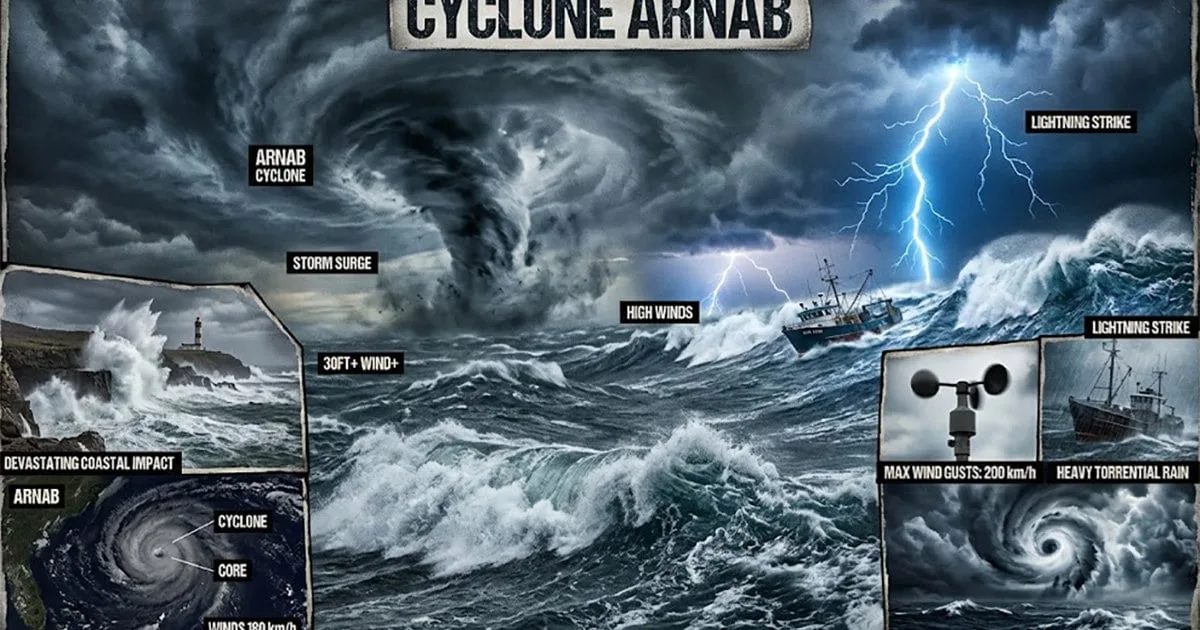
Photo: Amar Desh
Neutral summary
Bangladesh's Meteorological Department said Cyclone Arnab, formed over the Bay of Bengal, was about 755 km south of Payra port on Monday (26 October) and could intensify into a very severe cyclonic storm. Articles reported it was expected to cross the Andhra Pradesh coast in India on Wednesday, 28 October. Bangladeshi ports including Chattogram, Cox's Bazar, Mongla and Payra were advised to hoist warning signals, and fishing boats in the North Bay were told to stay near the coast. Bangladeshi forecasters said the storm was not forecast to strike Bangladesh directly, though rain was expected in parts of the country from 27 to 30 October. Andhra Pradesh Chief Minister N. Chandrababu Naidu ordered district administrations to stay on alert and set up control rooms.
Where accounts differ. Jugantor and Amar Desh give the storm's distance from Payra as 755 km and 745 km, while bdnews24 gives 865 km; Ajker Patrika, published 24 October, describes it only as a depression that may strike Odisha or Andhra Pradesh and is left out.
 Amar Desh
 Bhola News
 Jugantor
 bdnews24.com
Written by AI from these outlets' articles: facts they report, claims attributed, numbers checked against the sources. It may still contain errors; read the originals.
Article analysis

Band AStraight reporting
Amar DeshNeutral
Plain weather report whose headline and narration relay the Met Office forecasts and meteorologists' attributed views without evaluative language.
Nine of the nine outlets that covered this event headlined it neutrally.
Nothing in the headline, sourcing or narration pushes the reader.
1 Straight reporting10 Campaigning
The same event, one framing
The earliest headline of each kind. Marked words are judgements in the headline itself: stated as fact or in quotation marks.
Neutral 9 of 9
বঙ্গোপসাগরে নিম্নচাপ রূপ নিতে পারে সাইক্লোনে, কোথায় হানবে আঘাত
 Ajker Patrika
How the 1 was worked out
The model answers seven fixed questions from 0 to 3 and cites evidence for each. The score is calculated from the answers in code, so any disagreement points to one question.
-
G1
Reporter's own voiceNarration is descriptive throughout.0
-
G2
HeadlineReports the event or the speech act; contested claims are attributed.0
-
G3
Other side missingEvery party involved responds substantively.0
-
G4
Weight of the unanswered allegationNo allegation against an identifiable party.0
-
G5
Loaded quotesQuotes are informational.0
-
G6
Unattributed claimsEvery disputable claim is attributed.0
-
G7
Missing contextNecessary background is present.0
Evidence
1Word choiceReporter voice· not scored
ধেয়ে আসা
Mildly dramatic verb for cyclone movement, conventional in Bangla weather reporting and not evaluative of any party.
2MagnitudeAttributed quote voice· not scored
ব্যাপক ক্ষয়ক্ষতির আশঙ্কা
Unquantified scale word, but it sits inside a meteorologist's attributed forecast quote.
Show the calculation
S = G2 + … + G7 = 0 + 0 + 0 + 0 + 0 + 0 = 0
G1 = 0, below 2: not band D
G1 = 0 and S ≤ 1: band A
Band A: S = 0 gives 1, S = 1 gives 2. Score 1
Every headline, in order
-
Ajker Patrika
Bangladesh
First to report
Neutral
বঙ্গোপসাগরে নিম্নচাপ রূপ নিতে পারে সাইক্লোনে, কোথায় হানবে আঘাত
-
 Channel 24
Bangladesh
Neutral
-
Amar Desh
Bangladesh
Analysed above
Neutral
শক্তি বাড়াচ্ছে ঘূর্ণিঝড় ‘অর্ণব’, কখন কোথায় আঘাত হানতে পারে?
Headline changed; now
শক্তি বাড়াচ্ছে ঘূর্ণিঝড় ‘অর্ণব’, কখন কোথায় আঘাত হানতে পারে
26 Oct, 08:53 -
Bhola News
Bangladesh
Neutral
-
bdnews24.com
Bangladesh
Neutral
-
 NTV
Bangladesh
Neutral
-
 Dainik Amader Shomoy
Bangladesh
Neutral
About this method
Method. Bias types follow the Table of Media Bias Elements and the Media Bias Taxonomy (both CC BY 4.0). The impartiality rules follow the BBC Editorial Guidelines and the Ofcom Broadcasting Code. This analysis was made by claude-opus-5-5 on rubric 1.0.0. The score is calculated from the seven answers, never generated.
What this is not. No outlet gets a standing bias rating, and there is no left/right axis, because that axis does not describe Bangladeshi politics. Each analysis covers one article about one event. Members' analytics count how each outlet's headlines were labelled over a chosen period, with the number of headlines behind every share, and also show the average score of an outlet's scored articles: that average describes those articles (mostly each story's lead), not the outlet, and outlets are never ranked by it or by any share.
Known limits. Headlines are grouped into stories automatically, so an unrelated headline sometimes slips in; it is shown faded rather than hidden. Where outlets carry the same wire copy, the comparison has little to show. Human annotators agree on bias in Bangla news only moderately (κ = 0.574 at best), which limits what any automated score can claim.