4 sourcesFirst reported yesterday at 16:00, updated 11 h ago
জাপানের সাথে দীর্ঘমেয়াদি অংশীদারিত্ব গড়তে প্রধানমন্ত্রীর সফর গুরুত্বপূর্ণ
prime minister japan visit for long term partnership
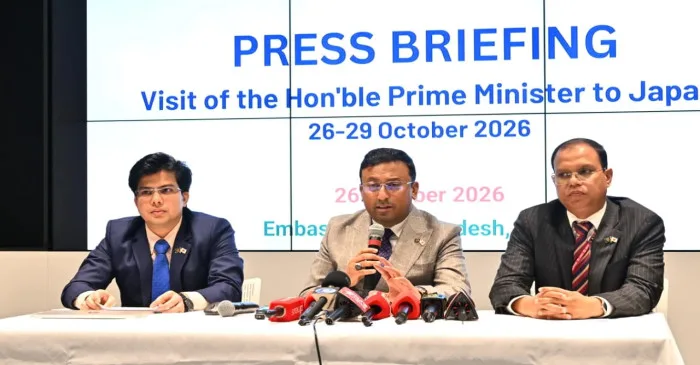
Photo: Daily Naya Diganta
Neutral summary
Foreign State Minister Humayun Kabir said at a press conference at the Bangladesh Embassy in Tokyo on Monday (26 October) that Prime Minister Tarique Rahman's visit to Japan creates an important opportunity for new areas of cooperation and a long-term partnership. He said the visit would help strengthen bilateral ties, expand trade and attract Japanese investment. On the first day, Rahman met a Japan-Bangladesh Parliamentary Friendship League delegation led by former prime minister Taro Aso, where discussions covered investment, trade and technology transfer, and Rahman invited Aso to visit Bangladesh. He also met Marubeni Corporation chairman Masumi Kakinoki, discussing trade, the economic partnership agreement (EPA), and Japanese investment in ICT, energy, fertilizer and industry, including the Karnaphuli Fertilizer plant. He met JICA president Akihiko Tanaka on continued development aid, and attended a dinner hosted by Nippon Foundation chairman Sasakawa. Kabir said the government aims to make Bangladesh an attractive investment destination.
 Daily Naya Diganta
 Dhaka Times
Written by AI from these outlets' articles: facts they report, claims attributed, numbers checked against the sources. It may still contain errors; read the originals.
Article analysis


Band BLocalised faults
Daily Naya DigantaNeutral
Relays a minister's upbeat briefing on the PM's Japan visit, dropping attribution in the headline and once calling talks positive in its own voice, with only government sources.
Four of the four outlets that covered this event headlined it neutrally.
The faults are local; the reporter's narration stays descriptive.
1 Straight reporting10 Campaigning
The same event, one framing
The earliest headline of each kind. Marked words are judgements in the headline itself: stated as fact or in quotation marks.
Neutral 4 of 4
জাপানের সাথে দীর্ঘমেয়াদি অংশীদারিত্ব গড়তে প্রধানমন্ত্রীর সফর গুরুত্বপূর্ণ
Daily Naya Diganta
How the 4 was worked out
The model answers seven fixed questions from 0 to 3 and cites evidence for each. The score is calculated from the answers in code, so any disagreement points to one question.
-
G1
Reporter's own voiceOne isolated evaluative word in the reporter's voice. Evidence 41
-
G2
HeadlineCompresses or intensifies, but the claim stays attributed. Evidence 11
-
G3
Other side missingEvery party involved responds substantively.0
-
G4
Weight of the unanswered allegationNo allegation against an identifiable party.0
- G5 1
-
G6
Unattributed claimsOne or two disputable claims are unattributed. Evidence 41
-
G7
Missing contextMinor context is missing. Evidence 51
Evidence
1Headline-body attribution mismatchHeadline voice
জাপানের সাথে দীর্ঘমেয়াদি অংশীদারিত্ব গড়তে প্রধানমন্ত্রীর সফর গুরুত্বপূর্ণ
Headline states the minister's evaluation that the visit is important without attribution.
2Mud and honeyAttributed quote voice
প্রধানমন্ত্রী বিশ্রাম না নিয়ে
Quoted praise of the PM's personal diligence, relayed from a government minister.
3Mud and honeyAttributed quote voice
প্রধানমন্ত্রীর কর্মস্পৃহা ও দেশের স্বার্থকে অগ্রাধিকার দেয়ার মানসিকতা
Laudatory characterisation of the PM in the quoted minister's words.
4Word choiceReporter voice
ইতিবাচক আলোচনা হয়
Narration evaluates the meeting as positive without attribution.
5Source selectionReporter voice
বাসস
State news agency relays a government press briefing with only government sources and no independent voice.
Show the calculation
S = G2 + … + G7 = 1 + 0 + 0 + 1 + 1 + 1 = 4
G1 = 1, below 2: not band D
Not band C or A: band B
Band B: S ≤ 3 gives 3, 4 to 6 gives 4, 7 or more gives 5. Score 4
Every headline, in order
-
Daily Naya Diganta
Bangladesh
Analysed above
Neutral
জাপানের সাথে দীর্ঘমেয়াদি অংশীদারিত্ব গড়তে প্রধানমন্ত্রীর সফর গুরুত্বপূর্ণ
About this method
Method. Bias types follow the Table of Media Bias Elements and the Media Bias Taxonomy (both CC BY 4.0). The impartiality rules follow the BBC Editorial Guidelines and the Ofcom Broadcasting Code. This analysis was made by claude-opus-5-5 on rubric 1.0.0. The score is calculated from the seven answers, never generated.
What this is not. No outlet gets a standing bias rating, and there is no left/right axis, because that axis does not describe Bangladeshi politics. Each analysis covers one article about one event. Members' analytics count how each outlet's headlines were labelled over a chosen period, with the number of headlines behind every share, and also show the average score of an outlet's scored articles: that average describes those articles (mostly each story's lead), not the outlet, and outlets are never ranked by it or by any share.
Known limits. Headlines are grouped into stories automatically, so an unrelated headline sometimes slips in; it is shown faded rather than hidden. Where outlets carry the same wire copy, the comparison has little to show. Human annotators agree on bias in Bangla news only moderately (κ = 0.574 at best), which limits what any automated score can claim.