11 sourcesFirst reported yesterday at 08:53, updated 16 h ago
অটোমোবাইল ও জ্বালানিতে জাপানি বিনিয়োগের আহ্বান প্রধানমন্ত্রীর
prime minister invites japanese investment in automobiles and energy
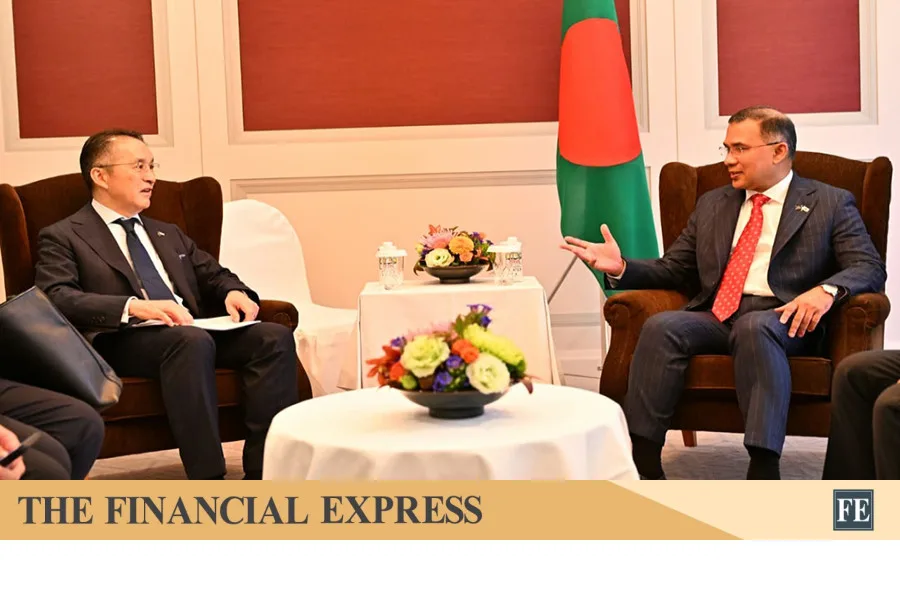
Photo: The Financial Express
Neutral summary
Prime Minister Tarique Rahman sought Japanese investment in Bangladesh's information and communication technology, renewable energy and advanced manufacturing sectors during a courtesy meeting in Tokyo with Masumi Kakinoki, chairman of Marubeni Corporation and of the Japan-Bangladesh Committee for Commercial and Economic Cooperation (JBCCEC), according to his deputy press secretary Shahadat Shadhin. Rahman said the government is committed to an investment-friendly environment through regulatory reform, simpler approval procedures and public-private partnerships. He also asked for Japanese help modernising Karnaphuli Fertilizer Company Limited (KAFCO) and assessing a second fertiliser plant, and sought support for the Bangladesh Special Economic Zone. Kakinoki expressed hope that effective implementation of the Economic Partnership Agreement would expand trade and investment. The meeting took place on Monday during a four-day visit with a 16-member delegation. A Marubeni delegation had met Rahman in Dhaka on October 11.
Where accounts differ. The Financial Express and Purbokone report that Rahman sought support for the Bangladesh Special Economic Zone, which The Daily Star, Banglanews24.com and Boishakhi Television do not mention.
 The Financial Express
 Banglanews24.com
 The Daily Star
 Boishakhi Television
 Dainik Purbokone
Written by AI from these outlets' articles: facts they report, claims attributed, numbers checked against the sources. It may still contain errors; read the originals.
Article analysis


Band AStraight reporting
The Daily StarNeutral
Reports a diplomatic meeting descriptively, with a factual headline and attributed statements, relying on the government press office readout without evaluative narration.
Eleven of the eleven outlets that covered this event headlined it neutrally.
Nothing in the headline, sourcing or narration pushes the reader.
1 Straight reporting10 Campaigning
The same event, one framing
The earliest headline of each kind. Marked words are judgements in the headline itself: stated as fact or in quotation marks.
Neutral 11 of 11
PM seeks greater Japanese investment in ICT, renewable energy
The Financial Express
How the 1 was worked out
The model answers seven fixed questions from 0 to 3 and cites evidence for each. The score is calculated from the answers in code, so any disagreement points to one question.
-
G1
Reporter's own voiceNarration is descriptive throughout.0
-
G2
HeadlineReports the event or the speech act; contested claims are attributed.0
-
G3
Other side missingEvery party involved responds substantively.0
-
G4
Weight of the unanswered allegationNo allegation against an identifiable party.0
-
G5
Loaded quotesQuotes are informational.0
-
G6
Unattributed claimsEvery disputable claim is attributed.0
-
G7
Missing contextNecessary background is present.0
Evidence
1Source selectionReporter voice· not scored
said PM’s Deputy Press Secretary Shahadat Shadhin
The account relies solely on the government press office, which is standard for a protocol meeting readout.
Show the calculation
S = G2 + … + G7 = 0 + 0 + 0 + 0 + 0 + 0 = 0
G1 = 0, below 2: not band D
G1 = 0 and S ≤ 1: band A
Band A: S = 0 gives 1, S = 1 gives 2. Score 1
Every headline, in order
-
The Financial Express
Bangladesh
First to report
Neutral
PM seeks greater Japanese investment in ICT, renewable energy
-
The Daily Star
Bangladesh
Analysed above
Neutral
PM seeks Japanese investment in fertiliser, ICT, renewable energy
-
 Prothom Alo
Bangladesh
Neutral
অটোমোবাইল ও জ্বালানিতে জাপানি বিনিয়োগের আহ্বান প্রধানমন্ত্রীর
-
 Dainik Amader Shomoy
Bangladesh
Neutral
About this method
Method. Bias types follow the Table of Media Bias Elements and the Media Bias Taxonomy (both CC BY 4.0). The impartiality rules follow the BBC Editorial Guidelines and the Ofcom Broadcasting Code. This analysis was made by claude-opus-5-5 on rubric 1.0.0. The score is calculated from the seven answers, never generated.
What this is not. No outlet gets a standing bias rating, and there is no left/right axis, because that axis does not describe Bangladeshi politics. Each analysis covers one article about one event. Members' analytics count how each outlet's headlines were labelled over a chosen period, with the number of headlines behind every share, and also show the average score of an outlet's scored articles: that average describes those articles (mostly each story's lead), not the outlet, and outlets are never ranked by it or by any share.
Known limits. Headlines are grouped into stories automatically, so an unrelated headline sometimes slips in; it is shown faded rather than hidden. Where outlets carry the same wire copy, the comparison has little to show. Human annotators agree on bias in Bangla news only moderately (κ = 0.574 at best), which limits what any automated score can claim.