5 sourcesFirst reported yesterday at 07:29, updated 4 h ago
Mass outages as Sudan RSF drones hit power stations
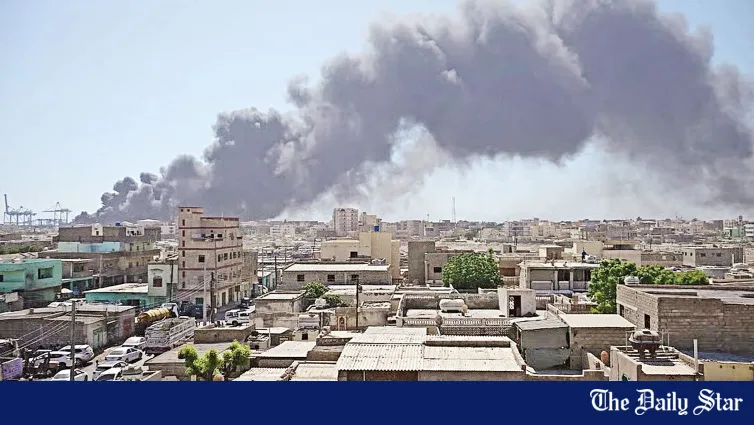
Photo: The Daily Star
Neutral summary
Sudan's paramilitary Rapid Support Forces (RSF) launched a coordinated drone attack on five power stations, according to a government official who spoke to AFP on condition of anonymity. The drones hit two stations each in Al-Jazira and Gedaref states and one in White Nile state, causing power outages across large parts of the three states. All three are controlled by the Sudanese army, which has been at war with the RSF since April 2023. The UN has repeatedly warned that attacks on power stations threaten health and services for millions facing the world's largest hunger crisis. An AFP correspondent reported power in Al-Jazira had been out since 2 a.m. (0000 GMT), and a Gedaref resident said the same. Residents and farmers described losses, including spoiled food and medication risks. The Hindu reported over 300 people were killed in drone strikes in the first three weeks of October, according to a UN tally.
Where accounts differ. The Daily Star reports only the government official's account of the attack, while The Hindu adds residents' accounts, a UN death tally and details on the wider war, which The Daily Star does not include.
 The Hindu
 The Daily Star
Written by AI from these outlets' articles: facts they report, claims attributed, numbers checked against the sources. It may still contain errors; read the originals.
Article analysis

Band COne-sided, no editorial voice
The Daily StarNeutral
Headline asserts RSF responsibility as fact though the body rests it on one unnamed government official; the narration is otherwise descriptive, but the RSF is not heard.
Five of the five outlets that covered this event headlined it neutrally.
The reporter's own narration carries no evaluation, which keeps it out of the top band (8 to 10).
1 Straight reporting10 Campaigning
The same event, one framing
The earliest headline of each kind. Marked words are judgements in the headline itself: stated as fact or in quotation marks.
Neutral 5 of 5
Sudan RSF drones target five power stations across country: govt official
Arab News
How the 6 was worked out
The model answers seven fixed questions from 0 to 3 and cites evidence for each. The score is calculated from the answers in code, so any disagreement points to one question.
-
G1
Reporter's own voiceNarration is descriptive throughout.0
-
G2
HeadlineAsserts a contested claim in the paper's voice. Evidence 12
-
G3
Other side missingThe other side is absent, with no sign a response was sought. Evidence 23
-
G4
Weight of the unanswered allegationAllegation of crime, violence or grave moral fault. Evidence 23
-
G5
Loaded quotesQuotes are informational.0
-
G6
Unattributed claimsEvery disputable claim is attributed.0
-
G7
Missing contextNecessary background is present.0
Evidence
1Headline-body attribution mismatchHeadline voice
Mass outages as Sudan RSF drones hit power stations
Headline states RSF responsibility as fact while the body attributes it to a single unnamed government official.
2CoverageReporter voice
a government official told AFP
The accused RSF is not quoted and there is no sign a response was sought.
3Source selectionReporter voice
a government official
Sole source is an unnamed official from the army-aligned government, a belligerent party.
Show the calculation
S = G2 + … + G7 = 2 + 3 + 3 + 0 + 0 + 0 = 8
G1 = 0, below 2: not band D
G3 ≥ 2, and G2, G5 or G6 ≥ 2: band C
Band C: S ≤ 12 gives 6, 13 or more gives 7. Score 6
Every headline, in order
-
Arab News Middle East First to report Neutral
Sudan RSF drones target five power stations across country: govt official
-
The Hindu
South Asia
Neutral
Mass outages in Sudan after RSF drones hit five power stations
-
The Daily Star
Bangladesh
Analysed above
Neutral
-
 The Rio Times
Latin America
Neutral
About this method
Method. Bias types follow the Table of Media Bias Elements and the Media Bias Taxonomy (both CC BY 4.0). The impartiality rules follow the BBC Editorial Guidelines and the Ofcom Broadcasting Code. This analysis was made by claude-opus-5-5 on rubric 1.0.0. The score is calculated from the seven answers, never generated.
What this is not. No outlet gets a standing bias rating, and there is no left/right axis, because that axis does not describe Bangladeshi politics. Each analysis covers one article about one event. Members' analytics count how each outlet's headlines were labelled over a chosen period, with the number of headlines behind every share, and also show the average score of an outlet's scored articles: that average describes those articles (mostly each story's lead), not the outlet, and outlets are never ranked by it or by any share.
Known limits. Headlines are grouped into stories automatically, so an unrelated headline sometimes slips in; it is shown faded rather than hidden. Where outlets carry the same wire copy, the comparison has little to show. Human annotators agree on bias in Bangla news only moderately (κ = 0.574 at best), which limits what any automated score can claim.