21 sourcesFirst reported yesterday at 05:53, updated 9 h ago
ইরানের সঙ্গে জরুরি বৈঠকে সৌদি-পাকিস্তান-তুরস্ক, নেপথ্যে কী?
saudi pakistan turkey emergency meeting with iran over unknown motive
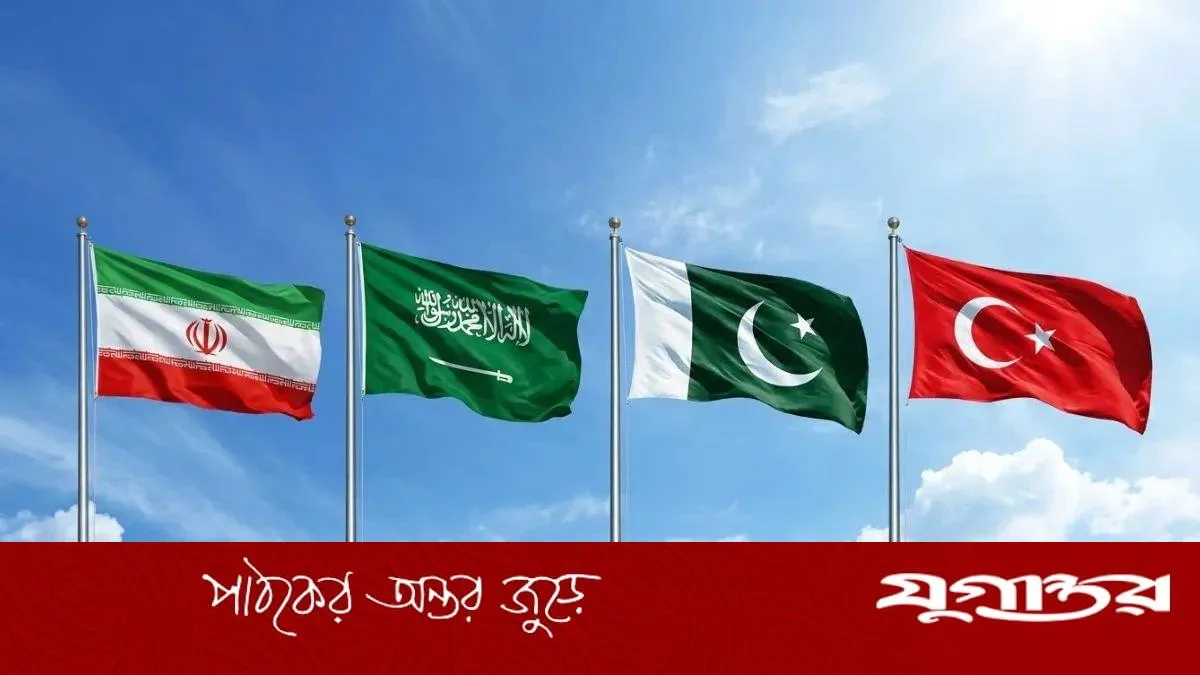
Photo: Jugantor
Neutral summary
Senior officials from Saudi Arabia, Turkey and Pakistan met Iranian officials in Tehran on Monday, 26 October 2026, to discuss regional security, according to Iranian state broadcaster IRIB and Reuters. IRIB named Saudi Defence Minister Khalid bin Salman, Pakistani army chief General Asim Munir and Turkish intelligence chief Ibrahim Kalin as participants, with Iran's security chief Mohsen Rezaei also present. Iranian official Ali Bagheri Kani said regional security arrangements and countering US and Israeli interference were part of Tehran's strategy. Saudi Deputy Minister Rayed Krimly said the visit aimed at de-escalation and dialogue, supporting mediation by Qatar and Pakistan. A joint statement reported by Anadolu said the four countries agreed to continue talks on regional peace and security, including Israel's actions in the Middle East and the situation in Palestine and Lebanon. The meeting follows a broader war that began with US and Israeli strikes on Iran and has spread to Yemen.
Where accounts differ. Amar Desh and Manab Zamin report a joint statement and agreed continued talks, which only Amar Desh and Manab Zamin mention, while Haaretz, The Punch and Jugantor describe the meeting purpose mainly as de-escalation without that statement.
 Jugantor
 The Punch
 Manab Zamin
 Amar Desh
 Haaretz
Written by AI from these outlets' articles: facts they report, claims attributed, numbers checked against the sources. It may still contain errors; read the originals.
Article analysis


Band BLocalised faults
JugantorNeutral
Mostly attributed report of a four-country meeting, with a headline that labels it urgent and teases hidden motives the body never explains.
21 of the 21 outlets that covered this event headlined it neutrally.
The faults are local; the reporter's narration stays descriptive.
1 Straight reporting10 Campaigning
The same event, one framing
The earliest headline of each kind. Marked words are judgements in the headline itself: stated as fact or in quotation marks.
Neutral 21 of 21
ইরানের সঙ্গে জরুরি বৈঠকে সৌদি-পাকিস্তান-তুরস্ক, নেপথ্যে কী?
Jugantor
How the 3 was worked out
The model answers seven fixed questions from 0 to 3 and cites evidence for each. The score is calculated from the answers in code, so any disagreement points to one question.
-
G1
Reporter's own voiceOne isolated evaluative word in the reporter's voice. Evidence 31
- G2 1
-
G3
Other side missingEvery party involved responds substantively.0
-
G4
Weight of the unanswered allegationNo allegation against an identifiable party.0
-
G5
Loaded quotesQuotes are informational.0
-
G6
Unattributed claimsOne or two disputable claims are unattributed. Evidence 31
-
G7
Missing contextMinor context is missing. Evidence 11
Evidence
1Emotional sensationalismHeadline voice
নেপথ্যে কী?
Teaser question implies hidden motive without the body answering it.
2Word choiceHeadline voice
জরুরি বৈঠকে
Headline calls the meeting 'urgent' though the body never describes it as an emergency.
3Unsubstantiated claimReporter voice
চার দেশের এই বৈঠক বিশেষ গুরুত্ব পাচ্ছে
Significance claim stated without source.
4Word choiceParaphrased source voice· not scored
বিদেশি হস্তক্ষেপ
Iranian official's framing of US and Israel, attributed, not adopted by the paper.
Show the calculation
S = G2 + … + G7 = 1 + 0 + 0 + 0 + 1 + 1 = 3
G1 = 1, below 2: not band D
Not band C or A: band B
Band B: S ≤ 3 gives 3, 4 to 6 gives 4, 7 or more gives 5. Score 3
Every headline, in order
-
Jugantor
Bangladesh
Analysed above
Neutral
-
 ARY News
South Asia
Neutral
-
 New Age
Bangladesh
Neutral
-
 The Daily Ittefaq
Bangladesh
Neutral
-
 Dhaka Post
Bangladesh
Neutral
মক্কা জোট : সৌদি, তুরস্ক আর পাকিস্তানের সঙ্গে বৈঠকে বসছে ইরান
-
 Samakal
Bangladesh
Neutral
ইরানে বৈঠকে বসছেন সৌদি-তুরস্ক-পাকিস্তানের কর্মকর্তারা, লক্ষ্য কী?
-
The Punch
Africa
Neutral
-
 The New Arab
Middle East
Neutral
Saudi Arabia, Turkey and Pakistan to hold security talks in Iran
-
 DBC News
Bangladesh
Neutral
মক্কা জোটের তিন দেশ সৌদি, তুরস্ক ও পাকিস্তানের সঙ্গে বৈঠকে বসছে ইরান
-
 Amar Sangbad
Bangladesh
Neutral
-
Manab Zamin
Bangladesh
Neutral
-
 Dainik Amader Shomoy
Bangladesh
Neutral
-
 NDTV
South Asia
Neutral
Pakistan, Saudi, Turkey Meet Iran leaders In Bid To Stop War Restarting
About this method
Method. Bias types follow the Table of Media Bias Elements and the Media Bias Taxonomy (both CC BY 4.0). The impartiality rules follow the BBC Editorial Guidelines and the Ofcom Broadcasting Code. This analysis was made by claude-opus-5-5 on rubric 1.0.0. The score is calculated from the seven answers, never generated.
What this is not. No outlet gets a standing bias rating, and there is no left/right axis, because that axis does not describe Bangladeshi politics. Each analysis covers one article about one event. Members' analytics count how each outlet's headlines were labelled over a chosen period, with the number of headlines behind every share, and also show the average score of an outlet's scored articles: that average describes those articles (mostly each story's lead), not the outlet, and outlets are never ranked by it or by any share.
Known limits. Headlines are grouped into stories automatically, so an unrelated headline sometimes slips in; it is shown faded rather than hidden. Where outlets carry the same wire copy, the comparison has little to show. Human annotators agree on bias in Bangla news only moderately (κ = 0.574 at best), which limits what any automated score can claim.